Libby’s destruction of household belongings
The Death of Bunny MunroLibby’s destruction of household belongings transforms the Munros’ flat from a familiar domestic space into evidence of a crisis Bunny Munro cannot yet understand. Furniture, clothing, food, and personal keepsakes have been disturbed or damaged; as Bunny encounters them, he recognizes that the disorder is directed at him, feels responsible without knowing why, and remains unable to read the full meaning of what he sees.
The changed domestic space
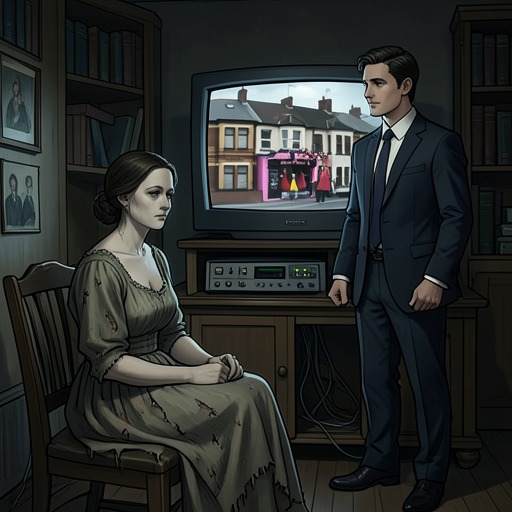
When Bunny returns, the flat is dark and disordered. The metal peg where he expects to hang his jacket has been snapped off, and the ceiling bulb has been removed. With only a lamp working, he sees furniture displaced: his armchair faces the wall beneath discarded clothes, while the dresser has been overturned and broken. His own clothes have been scattered, and some have been slashed or torn. These details make the damage more than generalized untidiness: the objects most clearly affected include Bunny’s possessions and the fittings through which he ordinarily uses the home.
The contrast with the flat’s earlier domestic familiarity is sharpened by Bunny’s memory of Libby painting the canary-yellow front door ten years before. In that brief recollection, she is crouched at the doorway, painting and smiling up at him. The painted entrance remains a point of connection to an earlier image of their life together, while the interior he now enters has been rearranged and damaged. The memory does not explain the destruction, but it places the changed home against a remembered scene of shared domestic care.
Objects made into a message
The disturbance extends beyond furniture and clothing. A box of Coco Pops has been emptied evenly across the hall carpet, so Bunny and Bunny Junior encounter the cereal underfoot as they move through the flat. On the coffee table, a high stack of pizza boxes and about a dozen unopened two-litre bottles of Coke contribute to the scene of disorder. Bunny Junior points out the cereal, while Bunny tells him not to stomp on it and rattles Libby’s locked bedroom door, calling for her. The damaged and scattered things shape the family’s immediate movements before Bunny can establish what has happened.
As Bunny later clears the flat, he discovers further damage to items associated with his own tastes and public self-image. His Avril Lavigne, Britney, and Beyoncé CDs have been put into the toilet cistern. The contents of a bootleg Tommy and Pamela video, a gift from his employer Geoffrey, have been pulled out and spread around the bedroom ceiling light. A company-party headshot of Bunny, taken at The Wick, has been repeatedly forked in attempts to attach it to the bathroom wall; the marks left in the woodchip form a patterned sequence. The varied objects—music, a gift, and a portrait—make the destruction feel personally addressed, though they do not provide Bunny with a clear account of Libby’s intentions.
Bunny’s response and incomplete understanding
Bunny recognizes the damage as personal: he notices that his clothes have been cut or torn and senses that the state of the flat is a message. At the same time, his recognition remains incomplete. Guilt rises in him, but he cannot identify its source; the narrative presents it as an unease that briefly surfaces and recedes rather than as a settled explanation. His immediate reaction is also compromised by resentment: he concludes that sexual intimacy with Libby is unlikely, and that frustration overtakes his emerging awareness of the harm within the household.
That mismatch between the force of the message and Bunny’s ability to receive it defines the episode. The scattered belongings are legible to him as accusation, but not as a statement he can answer. He interprets the damage as intensely personal, yet his attention turns quickly toward his own deprivation and anger. The flat’s objects therefore register both Libby’s rupture with the domestic order and Bunny’s limited capacity, at this point, to understand what that rupture asks of him.
Aftermath and significance
Bunny makes some effort to restore order and, in doing so, discovers how extensive the damage is. The cleared space does not settle his interpretation: he continues to feel blamed and victimized, while also acknowledging that Libby has a medical condition and depression. His understanding thus holds two reactions together without resolving them—recognition that she is unwell, and a sense that the destruction is aimed at him. The account gives no direct scene of Libby carrying out the acts and does not make the objects a complete explanation of her crisis.
The state of the home also persists into the family’s contact with outside support. Two social workers arrive without prior arrangement to check how Bunny and Bunny Junior are coping. Bunny is glad that he has begun putting the flat right, but wishes he were less intoxicated. The visit does not establish that the damage prompted their arrival; it does show the disrupted home as part of the circumstances in which the father and son are being assessed. In this way, the destruction has consequences beyond the objects themselves: it alters the space Bunny must inhabit, shapes his response to Libby, and remains visible during the scrutiny of the family’s ability to manage.